

Celebrating Yourself as a Woman in Tech: Self-Advocacy, Impact, and Visibility at Work
International Women’s Day reminded me of something quieter: self-advocacy

Self-advocacy in tech can feel uncomfortable, but it matters more than we often realize. Learn practical ways to communicate your impact, track achievements, and prepare for important discussions (performance reviews, interviews etc.)

March 8th marked International Women’s Day (IWD), and throughout the month many communities take time to celebrate women and their achievements.
In tech, these conversations often highlight leadership, representation, and progress across the industry.
Those conversations are important.
But this year I found myself thinking about something slightly different.
Celebrating yourself.
Not the loud kind of celebration that comes from awards, promotions, or public recognition.
The quieter kind.
The moment when you pause and recognize how much you have learned, the problems you have solved, and the systems you helped shape.
March can be a reminder to acknowledge that journey.
But maybe the most important part is remembering that we do not need to wait for a specific day or month to celebrate our own growth.
Sometimes the most meaningful recognition is the one we give ourselves.
And in practice, this often comes down to something simple but powerful: self-advocacy at work.
Learning how to communicate the value of your work clearly.
This is also something I am still learning to do myself.
Why celebrating yourself feels hard in tech
For many women in tech, celebrating their own work feels uncomfortable.
Not because the work is not valuable.
But because many of us were not encouraged to talk openly about our achievements.
Early in a career, it is common to believe that good work should speak for itself. If something matters, someone will notice.
In reality, modern engineering environments are complex systems. Work happens across multiple teams, projects, and timelines. Even meaningful contributions can remain invisible if they are not articulated clearly.
Celebrating yourself in this context is not about ego. It is about making the impact of your work visible.
And that is an important professional skill.
Self-advocacy vs self-promotion (visibility through clarity)
Many people associate visibility at work with self-promotion.
They imagine constant updates, competing for attention, or making everything about themselves.
But self-advocacy is different.
Self-advocacy means helping others understand the value of your work.
It focuses on clarity rather than attention.
Instead of drawing attention to yourself, you make the outcome of your work understandable.
Impact > effort (a simple before/after example)
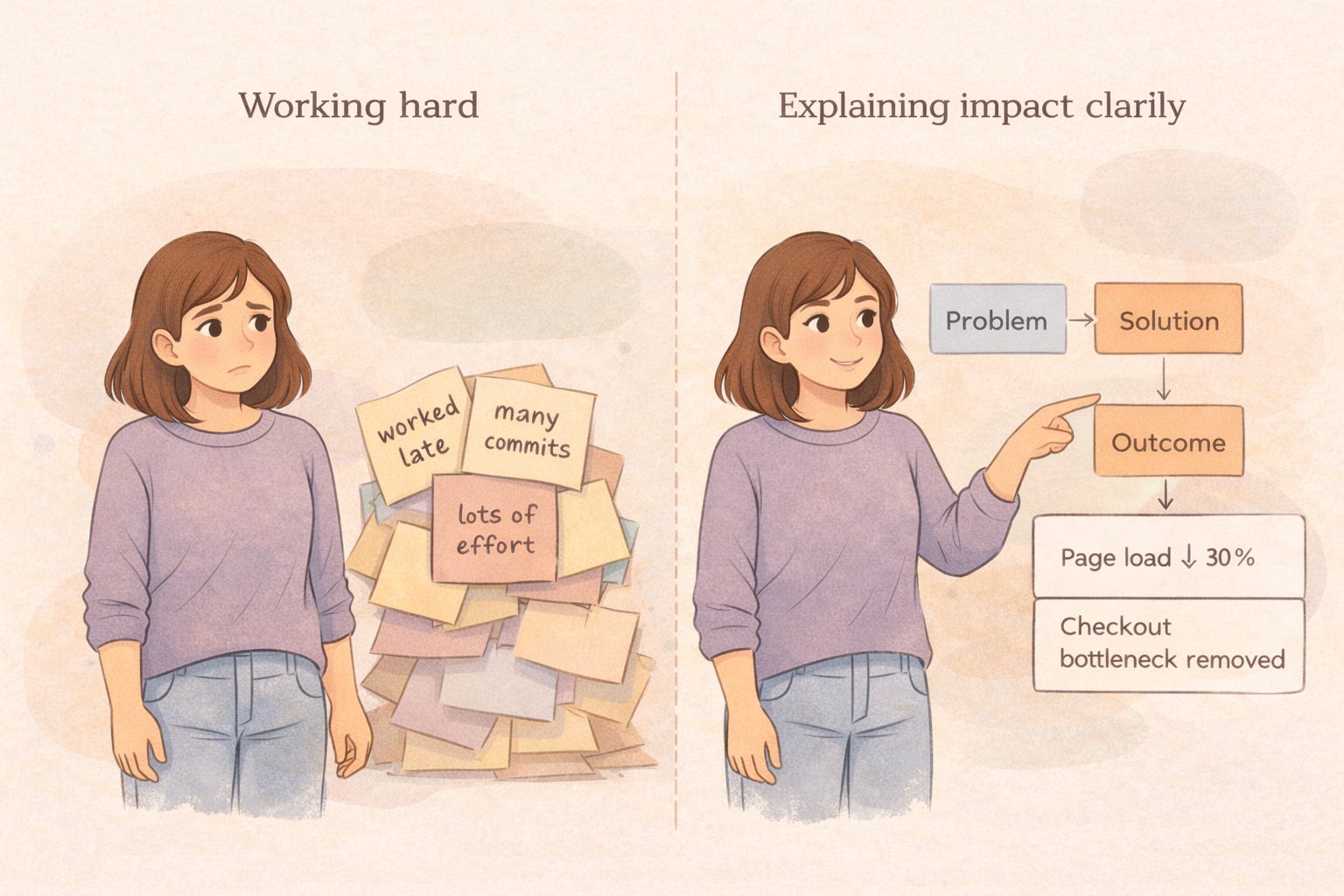
For example, instead of saying:
“I worked a lot on this feature.”
You might say:
“This feature reduced page load time by 30 percent and removed a bottleneck in our checkout flow.”
The difference is subtle but important.
Self-promotion centers the person.
Self-advocacy centers the impact.
When framed this way, sharing your work becomes easier. You are not asking for recognition. You are helping the team understand how the system improved.
Practical ways to celebrate your work (without forcing it)
Celebrating your work does not require dramatic gestures. Small habits can make a big difference.
Many of these habits are also useful when preparing for performance reviews, promotion discussions, or interviews.
Keep a brag document (what to track weekly)

One of the simplest tools for self-advocacy at work is a brag document.
A brag document is a private record of your work and contributions.
Once a week, write down a few things such as:
problems you solved
improvements you introduced
feedback from teammates
mentoring or collaboration moments
technical decisions that influenced a project
These notes may seem small in the moment. Over time they form a clear picture of your progress.
This document becomes especially useful before performance reviews or promotion discussions.
Instead of trying to remember months of work, you already have the history.
How to explain impact in 2–3 sentences (problem → action → outcome)
A simple structure can help you communicate your work clearly.
Think in terms of three elements:
The problem
The action you took
The outcome
For example:
“Our search interface struggled during peak traffic. I introduced caching and optimized the query strategy. The average response time dropped from 1.2 seconds to 400 milliseconds.”
This format works well when explaining your work during:
sprint demos
performance reviews
project updates
interviews
It keeps the explanation focused and highlights the real value of the work.
Team-friendly visibility (demos, retros, written updates)
Visibility does not need to feel uncomfortable.
Many teams already have natural spaces where work can be shared:
sprint demos
retrospectives
technical discussions
written updates in project channels
Instead of presenting updates as personal achievements, frame them as improvements to the system.
For example:
“I experimented with a different approach for state synchronization. It reduced unnecessary re-renders, so the dashboard feels much smoother now.”
This keeps the focus on the work while still communicating your contribution.
Make goals explicit (and track progress with your manager)
Another helpful habit is making sure your goals are visible and aligned with your manager.
When goals remain vague or undocumented, it becomes harder to show the progress you are making.
Instead, try to define clear goals and keep track of the steps you take toward them. This can be done through shared documents, performance tracking tools, or regular conversations with your manager.
Over time, this creates a visible record of your work and the outcomes you delivered.
Personally, this approach helped me a lot. By documenting the goals I set and the results I achieved, it became much easier to demonstrate the value of my work during performance discussions.
Instead of relying on memory, the progress was already visible.
And that makes conversations about growth much more concrete.
Common mistakes (and better alternatives)
One common mistake is assuming that silence will eventually lead to recognition.
Sometimes it does. Often it does not.
Another mistake is forcing visibility in ways that feel unnatural.
A better alternative is to focus on clarity.
Document your work
Explain your decisions
Share outcomes when they matter
These habits build visibility gradually without adding pressure.
Trade-offs and boundaries (visibility without burnout)
Visibility should not mean constantly proving yourself.
There is a balance between communicating impact and overextending your energy.
Some helpful boundaries include:
highlighting a few meaningful contributions instead of everything
documenting work once instead of repeating explanations many times
focusing on outcomes rather than hours spent
Visibility should support your work, not become another form of invisible labor.
The goal is clarity, not constant performance.
Checklist: prep for performance reviews, promotion chats, interviews
Before a performance review, career conversation, or even an interview, it can help to ask yourself a few questions:
What problems did I help solve this quarter?
Which decisions improved the system or the product?
Where did my work help the team move forward?
What feedback did I receive from colleagues?
What did I learn that changed how I approach problems?
Looking at your work through these questions often reveals more progress than you initially notice.
FAQ
What is a brag document?
A brag document is a personal record of your achievements, contributions, and learning moments.
It does not need to be complex. It can simply be a document where you regularly note the problems you solved, improvements you made, and feedback you received.
Over time, it becomes a powerful tool for performance reviews, promotion discussions, and interview preparation.
How do I self-advocate without sounding like I’m bragging?
Focus on impact instead of effort.
Instead of describing how hard you worked, explain what changed because of your work.
What improved?
What problem was solved?
What outcome did the team benefit from?
This shifts the conversation from self-promotion to clarity.
What if my work is mostly “invisible” (maintenance, reliability, mentoring)?
Some of the most valuable work in engineering is invisible.
Maintenance, reliability improvements, documentation, and mentoring often prevent problems before they appear.
These contributions strengthen systems and teams.
Documenting them and explaining their long-term impact helps others understand their value.
Takeaway
Celebrating yourself as a woman in tech does not mean becoming louder or more visible than you are comfortable with.
It means recognizing the value of your work and helping others see it clearly.
Your contributions shape systems, improve products, and support the people around you.
And acknowledging that impact is not arrogance.
It is simply recognizing the engineer you have become. 🌿
Until next time,
Stefania
Articles from the ♻️ Knowledge seeks community 🫶 collection: https://stefsdevnotes.substack.com/t/knowledgeseekscommunity
Articles from the ✨ Dev Shorts collection:
https://stefsdevnotes.substack.com/t/frontendshorts
Articles from 🚀 The Future of API Design series:
https://stefsdevnotes.substack.com/t/futureofapidesign
🗣️ If this article resonated with you
If this article resonated with you, consider recommending Stef’s Dev Notes to someone who might enjoy it.
This newsletter grows mostly through thoughtful readers sharing it with others in the industry. I appreciate every recommendation.
👋 Get in touch
Feel free to reach out to me, here, on Substack or on LinkedIn.
Stefania, this piece is very important. You described a big part of my career.
Switching into product management made me think more about the outcomes, and it was like I had a new perspective. But sometimes that's not enough.
I'm grateful that I found my group of like-minded women a couple of years ago. These women have been so supportive. We learn so much from each other.
I strongly suggest that people not navigate their careers alone!
Great piece - especially for women in tech.
Oftentimes, it's uncomfortable to self-advocate because it feels like boasting. But it's so important to make your work (and results) visible. If you're in bigger teams, it's easy to get overlooked.
Key advice from Stefania:
- Keep a brag document
- Set clear goals with manager
- Give context with updates