

The Future of API Design: When Purpose-Built APIs Go Wrong (And How to Fix Them)
♻️ Knowledge seeks community 🫶 #17

👋 Welcome back to Stef’s Dev Notes!
Some APIs break because they were poorly thought through.
Most drift because the product evolved faster than the contract.
Teams ship experiments. AI-generated logic grows without a clear boundary. New requirements appear. Multiple consumers interpret the same endpoint differently.
What originally made sense slowly becomes harder to reason about, harder to change, and harder to trust.
If you’ve been following this series:
👉 Article #1 explored why APIs need purpose, not just shape.
👉 Article #2 compared REST and GraphQL through the lens of experience.
👉 Article #3 discussed collaboration patterns across teams and tools.
👉 Article #4 focused on evolving APIs without breaking existing consumers.
Now we end the series by answering:
What do you do when an API that once made sense no longer fits the reality it serves?
📌 Table of Contents
What is API drift?
Why well-designed APIs drift over time
Signals and early warning signs
Make Drift Visible: Observability for Humans (Not Just Infra)
Fixing Drift Without Starting Over
The human side of API maintenance
Technical appendix
What Is API Drift?
API drift happens when the usage, design, or implementation of an API evolves away from its original intent.
It often results in:
inconsistencies
undocumented behavior
edge-case-driven complexity
hesitation or fear around making changes
API drift doesn’t mean the system is broken, it means the system is evolving faster than the contract guiding it.
Why Good APIs Drift (Even AI-Generated Ones)
API drift emerges when new requirements outgrow the original design assumptions.
Typical triggers:
New use cases that weren’t part of the early product vision
AI-generated business logic that adds behaviors no one explicitly designed
Frontend teams optimizing for speed and building assumptions into requests
A “temporary workaround” becoming the default behavior
Multiple teams consuming the API differently without shared guidelines
Here’s a simple example many teams have seen:
GET /user?id=123… later becomes:
GET /user?id=123&include=roles,settings,preferences,teams,pastSessionsEventually, no one knows:
What is required
What is optional
What happens if you request too much
Which query came first or why
The endpoint didn’t become bad.
Its purpose became unclear.
Signals That Drift Is Happening
You don’t need deep backend knowledge to notice signs.
Look for these symptoms:
🔹 The API behaves differently than the documentation
🔹 Teams rely on “tribal knowledge” or Slack threads
🔹 Different parts of the product use the same endpoint differently
🔹 AI tools or scaffolding generate new endpoints without consistency
🔹 Minor changes become risky because consumers may break
A simple mindset shift helps:
If consumers have to guess how an API works, the design has drifted.
Make Drift Visible: Observability for Humans (Not Just Infra)
Observability doesn’t need a dashboard, platform, or ops team.
Sometimes it starts with one question:
How are people actually using this API?
Ways to check without deep backend access:
✔ Look at API analytics in tools like Postman, Supabase, Firebase, Vercel, Kong, or Appwrite
✔ Search your codebase for how different components call the same endpoint
✔ Compare usage patterns: are consumers sending wildly different parameters?
✔ Use schema validation or contract testing tools (like Pydantic, Zod, or TypeScript types)
Helpful artifacts:
A snapshot of all requests being made
A diff between expected and actual schema
A list of undocumented behaviors
Once you see usage patterns, the design starts telling a story.
Fixing Drift Without Starting Over
You do not need to rebuild the whole API.
You need to realign intent with usage.
Here are practical evolution strategies that work across frontend-driven development, AI workflows, and modern serverless stacks:
Strategy 1: Group Capabilities Instead of Adding More Flags
Instead of:
GET /cart?promoOnly=true&withTotals=trueUse:
GET /cart?fields=totals,promotionsThis keeps the contract flexible as new needs emerge.
Strategy 2: Document Behavior as Rules, Not Endpoints
Treat the API like language, not plumbing.
Example template:
This endpoint exists to do: ____
It assumes: ____
It returns predictable results when: ____
Strategy 3: Validate Everything at the Boundary
AI-generated logic often sneaks in inconsistent responses.
Validation tools stop drift early:
Zod
TypeScript type generation
JSON Schema
Supabase row policies
Postman auto mock validation
Even frontend validation counts.
Strategy 4: Evolve With Feature Flags, Not Forked Endpoints
Instead of building:
/user/profile-v2Use:
GET /user/profile?version=2While both exist, observe usage and adoption.
The Human Layer of the Problem
The hardest part of fixing API drift is not the code.
It’s alignment.
Teams resist change when:
The purpose behind change is unclear
They fear breaking something unknowingly
AI tooling generates new logic faster than humans review it
No one knows who owns the contract long-term
To fix this, create light structure, not bureaucracy:
✔ A shared naming system
✔ A simple checklist for new endpoints
✔ A validation layer applied automatically
✔ A written migration plan that feels safe
APIs thrive when there is shared confidence, not shared hesitation.
Closing Thoughts
APIs are not static artifacts.
They are evolving agreements between:
Code
Product
People
Systems
AI-generated decisions
The context they serve
A strong API is not the one that starts perfect, but the one that continues to make sense as everything around it changes.
This concludes the core of the series.
If you missed any chapter:
📌 Article #1: The Problem & Vision
📌 Article #2: Schema vs Experience
📌 Article #3: Collaboration & DX
📌 Article #4: Migration Strategies
📌 Article #5: When Purpose-Built APIs Go Wrong (this one)
Next time, you’ll receive a bonus article resource 🎁.
Before you go:
Have you worked with an API that slowly drifted away from its purpose? What caused it?
Your examples will be featured in the upcoming bonus article.
Until next time,
Stefania
Technical Appendix: Practical Guide for AI-Assisted and Modern Development
(kept short but actionable)
Checklist for Early Detection
✔ The documentation no longer matches behavior
✔ Consumers override or reshape responses
✔ AI-generated endpoints don’t follow existing patterns
✔ Parameters multiply to cover too many cases
✔ Consumers need conditionals per request
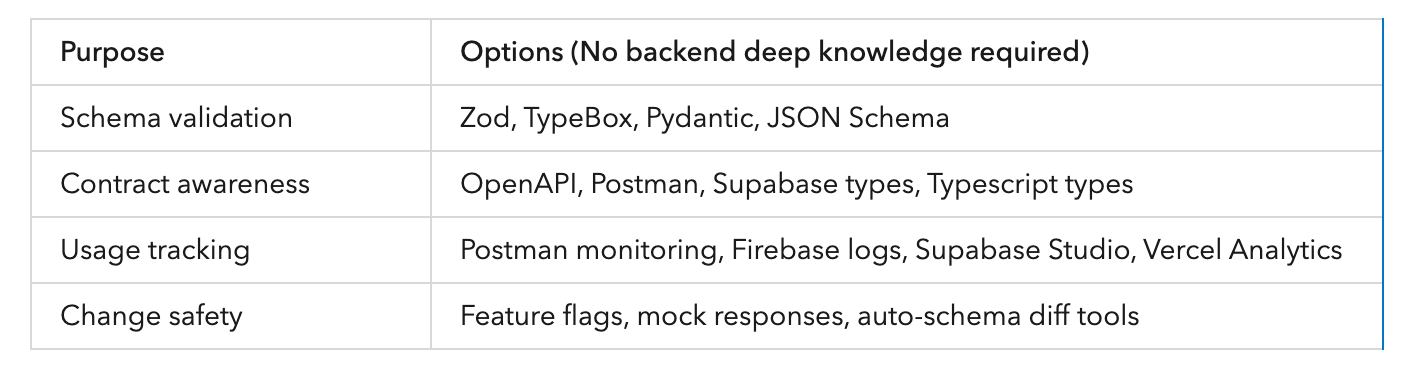
Recommended Tools (Depending On Stack)
Decision Guide
Use this rule of thumb:
If the API confuses consumers → clarify intent
If the API supports patterns but inconsistently → unify design
If the API supports too many special cases → restructure
If the API no longer matches the business → evolve the contract
Articles from the ♻️ Knowledge seeks community 🫶 collection: https://stefsdevnotes.substack.com/t/knowledgeseekscommunity
Articles from the ✨ Frontend Shorts collection:
https://stefsdevnotes.substack.com/t/frontendshorts
👋 Get in touch
Feel free to reach out to me, here, on Substack or on LinkedIn.