

I packed my life into a car, moved to Spain, and left my professional comfort zone behind.
What happens when you strip away your context and have to figure out, from scratch, who you are as an engineer?

Relocating countries mid-career is disorienting enough. But when the move coincides with an industry under pressure - layoffs, AI tools reshaping roles, shifting expectations for engineers - the questions it surfaces go deeper than logistics. This is about what happens when you strip away your professional context and have to figure out, from scratch, who you are as an engineer.
I packed everything I owned into a car and drove from Sweden to Spain.
Not a flight. Not a fresh start with a suitcase. Everything. The whole weight of it.
My dog included.
And without a job waiting on the other side.
And somewhere between countries, I realized something I wasn’t fully ready to admit: the questions I’d been carrying about my career had made the trip too.
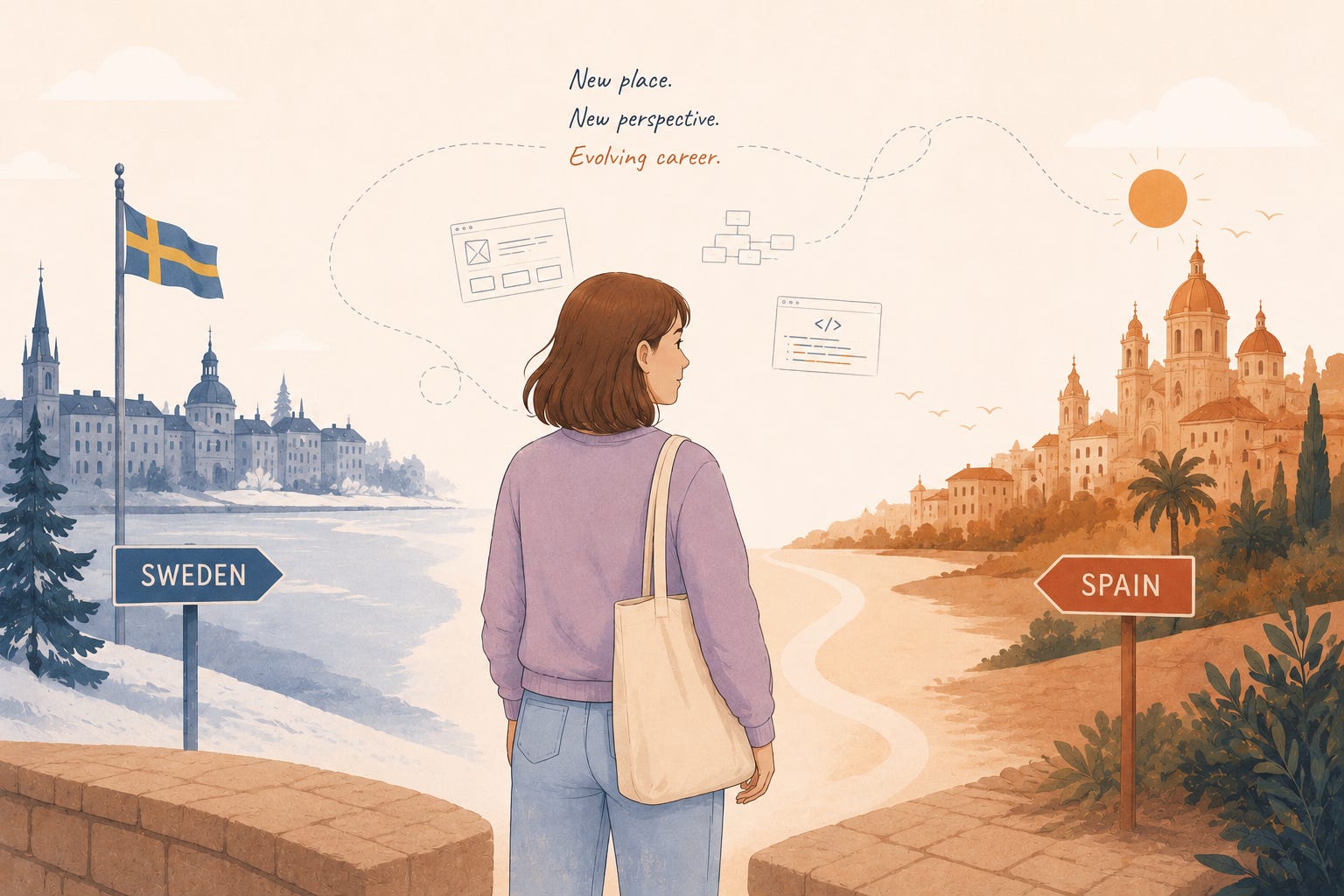
I thought I knew what my career was
I’ve been a frontend engineer for more than eight years.
For most of that time, I knew what that meant. What was expected. What good looked like. What the path forward looked like, more or less.
That clarity isn’t really there anymore.
And I don’t think it’s just me.
The shift didn’t announce itself
Earlier this year, I wrote about what a frontend day actually looks like — the invisible decisions, the judgment calls, the quiet craft behind things that “just work.” I meant every word of it and I still love it.

But something has shifted since then.
Not in what the work is. In whether the ground beneath it still feels solid.
The industry changed while I wasn’t looking directly at it
I didn’t get laid off. Nobody close to me did either.
But I started noticing how I react differently to the same signals.
A company announces cuts, and my first thought is no longer “that won’t happen here.” It’s “what would I do if it did?”
AI tools arrived fast, and I’ve been using them.
But the question I keep coming back to isn’t what they’ve taken. It’s what happens when building becomes accessible to everyone - and what that means for someone whose expertise was never really just about shipping code, but about making sure what gets shipped actually works for the person on the other side.
I don't have a clean answer yet. But I believe that "what's left for me in this shift" is a more honest question than "what's being taken."
Even the role feels harder to define now
Job descriptions still look familiar, but feel slightly off.
Conversations carry expectations that aren’t always explicit.
The daily work is harder to define than it was a couple of years ago.
The one question that keeps coming back: is the work I’ve spent years getting good at still the work that matters?
Not in a catastrophising way. More like standing in a room you’ve lived in for years and suddenly noticing the light has shifted.
Something is different. You just can’t point to exactly what yet.
The move didn’t cause it, but it removed the noise
The first few weeks in Madrid, I didn’t have routines yet. No commute. No team standup. No familiar place to open my laptop.
Just me, my partner and my dog, somewhere new.
The quiet that comes with that is different from ordinary quiet. It doesn’t fill in around your thoughts. It sits beside them.
The career questions I’d been half-ignoring for months stopped feeling optional.
I stopped expecting clean answers
I don’t have clean answers yet.
And I’ve stopped treating that as a problem.
Discomfort is not a signal that something has gone wrong. It’s usually a signal that something is changing.
A relocation. An industry mid-transformation. A role whose edges keep moving.
These aren’t problems to fix quickly. They are conditions you learn to operate within.
What shifted wasn’t certainty. It was the question I was asking.
I’d been asking: what’s left for me in this? As if the answer would come from measuring what AI hadn’t taken yet.
The question that feels more honest is different: where does judgment still matter? Where does knowing your users - actually knowing them, not inferring them from a prompt - change what gets built?
That’s a question I have something to contribute to. And that’s not nothing.
What I’m paying attention to instead
What I actually enjoy building.
Not just what I’m good at. Not the work that feels safest to put on a CV.
The interface. The user’s moment of contact with something someone built. Whether it serves a real need or just satisfies a brief. Whether the experience was thought through, or just functional.
That’s what I keep returning to. And in a moment where anyone can generate a working prototype in an afternoon, I think the question of whether it should exist in this form, for this person becomes more important than it’s ever been - not less.
I don’t know yet how that translates into what comes next. But it’s the most honest signal I have.
That’s the thread I’m following
Not because it’s certain.
But because it’s honest.
And for now, that feels like enough.
Until next time,
Stefania
Articles from the ♻️ Knowledge seeks community 🫶 collection: https://stefsdevnotes.substack.com/t/knowledgeseekscommunity
Articles from the ✨ Dev Shorts collection:
https://stefsdevnotes.substack.com/t/frontendshorts
Articles from 🚀 The Future of API Design series:
https://stefsdevnotes.substack.com/t/futureofapidesign
🗣️ If this article resonated with you
If this article resonated with you, consider recommending Stef’s Dev Notes to someone who might enjoy it.
This newsletter grows mostly through thoughtful readers sharing it with others in the industry. I really appreciate every recommendation.
🤍 A small gift for you
Stef’s Dev Notes is a community partner for WeAreDevelopers.
If you enjoy thoughtful conversations about frontend, systems, and growth, this is one of the spaces where those ideas come together at a larger scale.
🎟 You can join WeAreDevelopers World Congress (23–25 September, San José) and use this code Community_StefsDevsNotes for 10% off.
Enjoy your new adventure!
This sounds exciting. Congratulations on this decision. Hopefully many adventures ahead.