

On Substack, appreciation fades. So I built a place it stays.
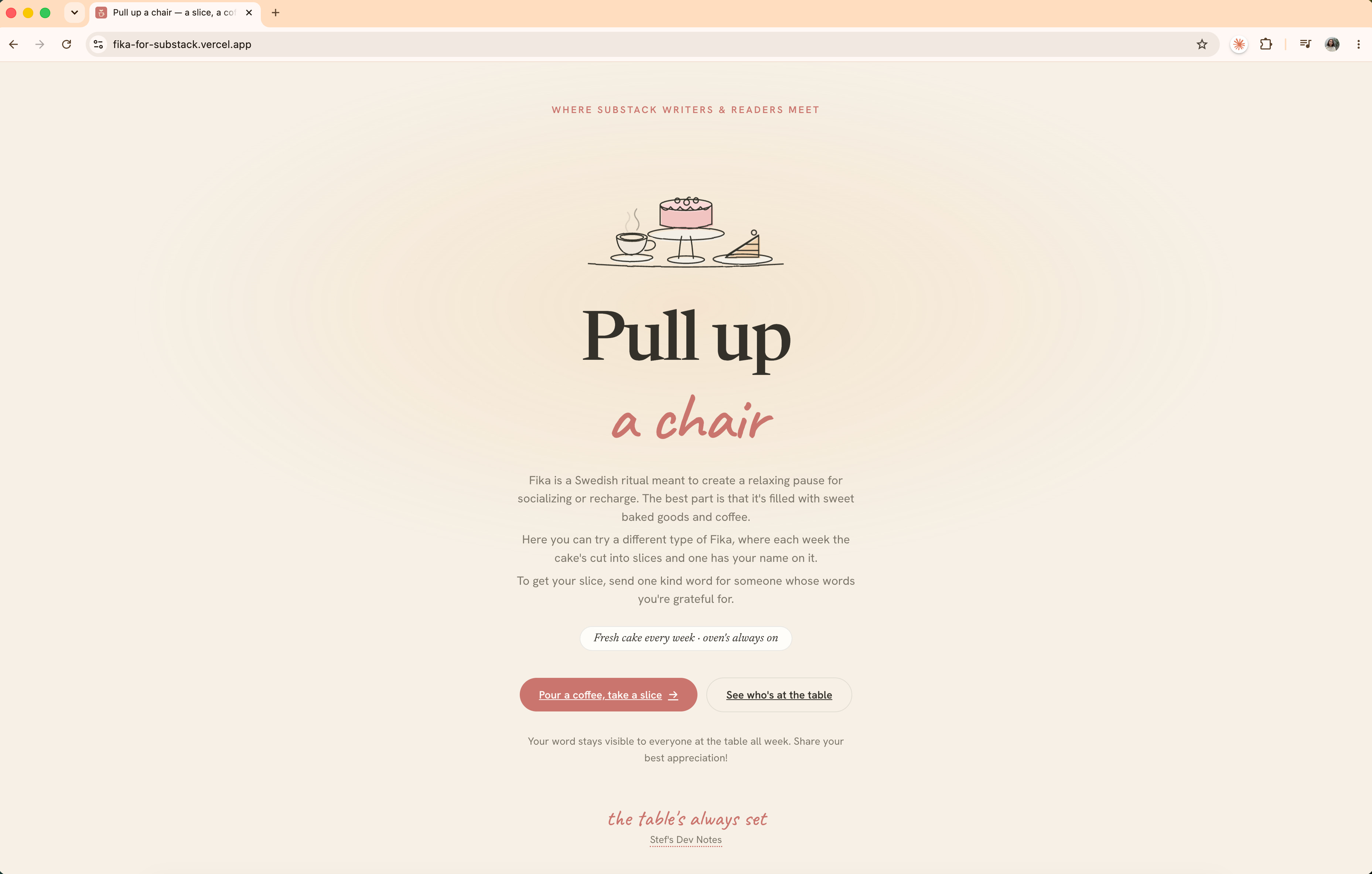
Introducing Fika For Substack — a weekly appreciation table for the readers and writers of Stef's Dev Notes

I turned 30 this month.
And I had an idea for a birthday cake — 30 slices, one for every year, where friends and readers could leave kind words. A digital appreciation wall.
But as I was building it, I realized the cake itself wasn’t the interesting part. The interesting part was what it could become if it didn’t disappear after the celebration.
So I put the birthday cake aside and built something else instead.
What Fika for Substack is
I lived in Sweden for a year, and one thing that stayed with me was fika — a coffee-and-cake break meant for slowing down and actually connecting with people.
I kept thinking about how rare that kind of pause is in online spaces.
This app works the same way:
Every week, a fresh cake with 12 slices appears
You take a slice by leaving a kind word for someone at the table
It can be a writer you follow, a fellow reader, a friend, the host (that’s me), or just “the table” — for anyone who might need it
A public appreciation wall keeps every slice forever
The cake resets every week, but the appreciation wall builds up week by week
And for now, there will be no accounts. No signup. No follower counts. Just your name, a message, and someone who might need to hear it.
The problem Substack doesn’t solve yet
Substack’s current recommendation system is built around algorithms and popularity signals — what’s trending, what’s getting restacked, what the network thinks is hot. But the writers that matter most to you don’t always show up there.
There is a way to recommend other writers — when you subscribe to someone, you see their recommendations. It’s a good start, but it’s also limited: that appreciation lives inside your inbox, visible only to your own subscribers. It’s not public. It doesn’t accumulate. It doesn’t create a shared space where a whole community can see who they value and why.
And beyond recommendations, the only way to show appreciation for a writer is through a comment or a note. Those aren’t nothing, but they’re easy to lose in the noise — buried under newer posts, scattered across threads, forgotten after a few days.
There’s no permanent place where appreciation lives. No wall that says: these are the writers this community actually values, and here’s why.
As a reader, I might love three or four writers on Substack. But there’s no space to say that publicly, and no way for other readers to discover them through my appreciation.
As a writer, I know some of my readers also write. But I rarely find out, because the signals are scattered and temporary.
The fika table is my attempt to build that missing space.
Why it looks the way it does
I made deliberate choices about what not to build in the MVP.
There are no leaderboards. No “most appreciated” rankings. No trending lists. No like buttons. No popularity feeds.
Not because algorithms are bad, but because I wanted to see what happens when there’s nothing to optimize for.
Does appreciation still flow when there’s no leaderboard to climb?
Does discovery happen when there’s no algorithm pushing content?
Do people leave slices for each other, not just for the host?
I don’t know the answers yet. But I want to learn them before I build anything smarter on top. The shape of real, unprompted appreciation is the signal I need first.
The MVP will follow these two principles:
The anti-FOMO principle: after submitting a slice, the first thing you see is your note published on the wall — not a share sheet. The share button is there if you want it, but the default experience is about the act of giving, not the pressure to distribute.
The low-friction principle: no email, no password, no profile setup. If you type a name and a message, you’re taking part at the Fika table.
Why it matters
Writers and readers share an ecosystem on Substack, but there’s rarely a place to interact outside of posts and their comment sections. Sure, there can be a newsletter’s subscriber chat, direct messages or even Discord channels, but all these serve another purpose. The fika table is that place where the only thing we care about is the appreciation.
A shared ritual that makes the community visible to itself.
Over time, the appreciation wall becomes more than a collection of notes. It becomes a record of whose words mattered, and why.
For writers, it’s a source of genuine feedback that doesn’t fit into a metric.
For readers, it’s a way to discover other writers through trust — someone you follow appreciated another writer, so maybe you will too.
That kind of discovery doesn’t need an algorithm right away.
Come try it
The table is set and the first cake is out.
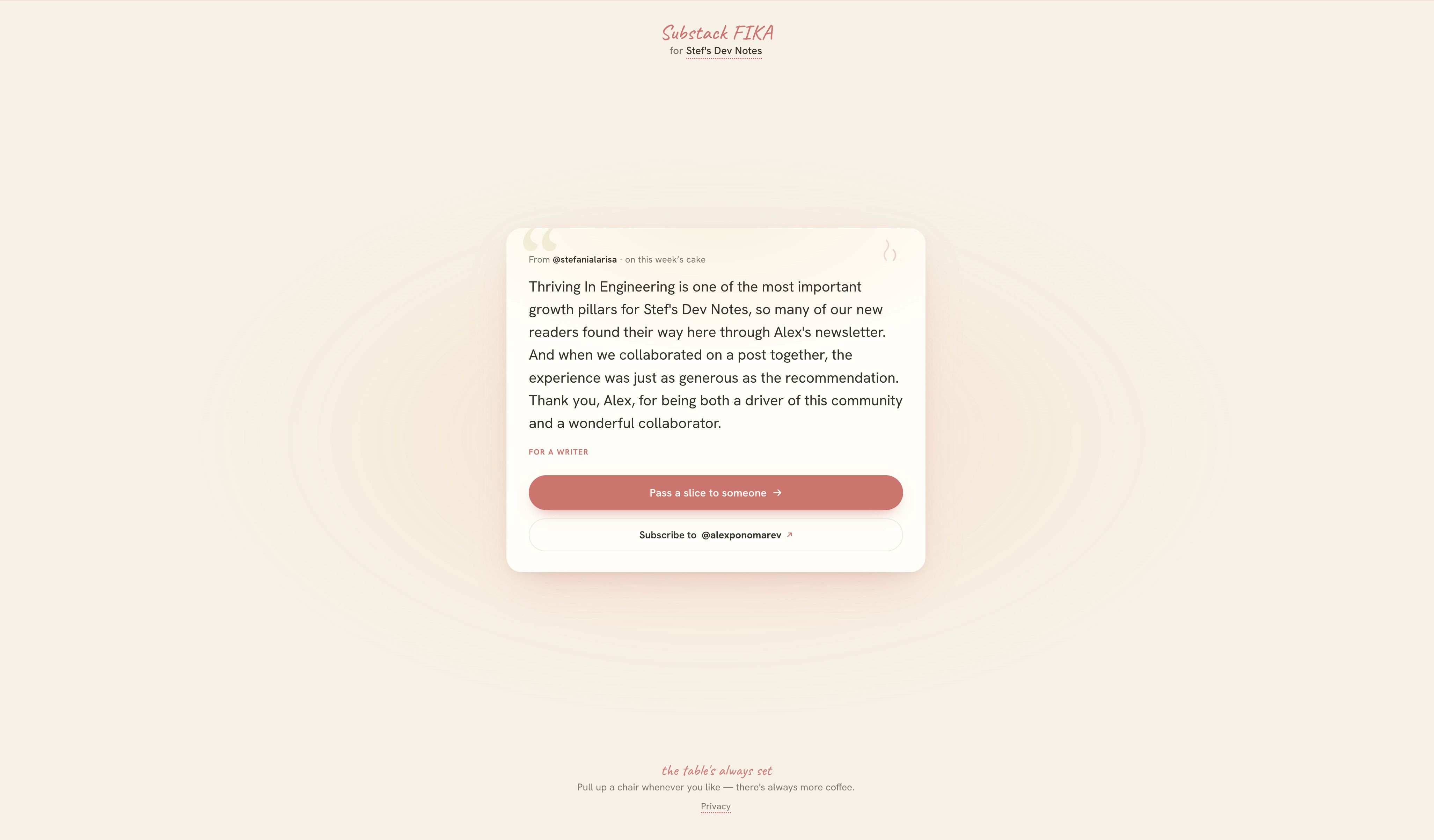
There are already 4 slices I shared — with a publication that supported me when I was starting out - Code Like A Girl, an active reader and writer who leaves the thoughtful and valuable comments - Marcos F. Lobo 🗻🧭 , a collaborator who also happens to be a go-to resource for product thinking Elena | AI Product Leader , and a writer whose work inspires me every day - Alex Ponomarev from Thriving In Engineering .
The rest of the cake is ready to be shared among you.
Here’s what I’d love you to do:
→ Pull up a chair, pour a coffee, take a slice (https://fika-for-substack.vercel.app/)
→ Leave a kind word for a writer whose work you love. For a reader whose comments you enjoy. For a friend. For the table. For anyone.
Then there’s also the option to share your slice link and make the table grow.
I’ll be watching the wall closely. The real test is whether readers leave slices for each other, not just for me. That’s the signal that tells me this idea is worth investing in.
What’s next
This is just an MVP for validation purposes. Minimal, warm, maybe a little rough around the edges.
But what I want is to understand what works and what doesn’t:
Was it easy to use it?
Did anything feel confusing or missing?
Would you want this in another writer’s Substack?
What feature would you add and why?
Leave a comment, reply to this email, or send me a DM on Substack. I would love to hear your feedback.
And if you’re curious about the technical side — how it’s built, the stack, the design decisions — I’ll follow up with a deep-dive post soon.
Until next time,
Stefania
Articles from the ♻️ Knowledge seeks community 🫶 collection:
https://stefsdevnotes.substack.com/t/knowledgeseekscommunity
Articles from the ✨ Dev Shorts collection:
https://stefsdevnotes.substack.com/t/frontendshorts
Articles from 🚀 The Future of API Design series:
https://stefsdevnotes.substack.com/t/futureofapidesign
🗣️ If this article resonated with you
If this article resonated with you, consider recommending Stef’s Dev Notes to someone who might enjoy it.
This newsletter grows mostly through thoughtful readers sharing it with others in the industry and I really appreciate every recommendation.
🤍 A small gift for you
I’m offering 3 free passes for a free week of Claude Code. First 3 people can grab one here: https://claude.ai/referral/PA9sLj-iTQ
I love that you took the time to make something that enriches the connection between people. Truly, that's what I love most about the internet.
Also, I like that you approached it like a little experiment.
Can't wait to see what you'll build next. Bravoo!